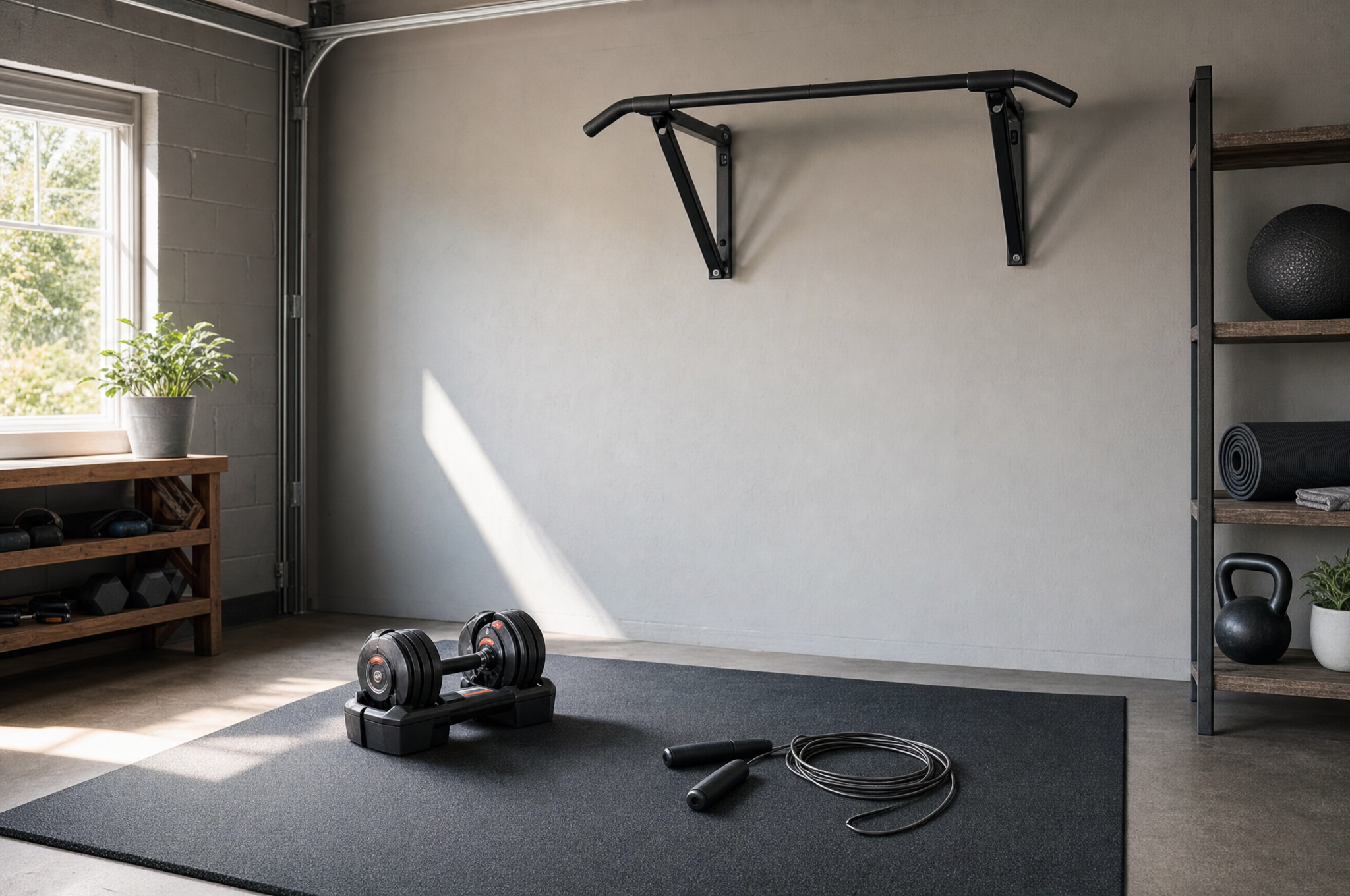
Let me guess: you've watched home gym videos on YouTube and concluded you need a power rack, a barbell, 300 lbs of plates, a bench, and about $1,500 minimum. You don't. For under $200, you can build a setup that trains every fundamental movement pattern and takes you through your first year of strength training. Here's exactly what to buy, what to skip, and why.
The shopping list: what to buy
1. Adjustable Dumbbells — $50–$80
This is the single most important purchase. A pair of adjustable dumbbells (the spin-lock kind, not the fancy selectorized dial kind) gives you a weight range from 5 to 50 lbs per hand in a compact footprint. Look for standard 1-inch plates — they're cheaper than Olympic plates and widely available used.
With adjustable dumbbells, you can train every pattern from our five fundamental movements guide: goblet squats, Romanian deadlifts, overhead presses, rows, and farmer's carries. They're the workhorse of a budget home gym.
2. Pull-Up Bar (Doorway) — $25–$35
A doorway pull-up bar unlocks the pull pattern — the one movement that's hardest to replicate with dumbbells alone. The lever-style bars that rest on top of the door frame (not the tension-mounted kind) are safer and more stable. Make sure your door frame can support the weight.
If you can't do a pull-up yet, the bar is still useful for hangs (grip and shoulder mobility), negatives (jump up, lower slowly), and inverted rows (feet on the floor, body under the bar). See our bodyweight progressions guide for the full path from zero to pull-ups.
3. Resistance Bands (Set) — $20–$30
A set of loop resistance bands (the flat kind, not the tube kind with handles) fills the gaps. Use them for: assisted pull-ups, band dislocates (shoulder mobility), banded rows, and adding accommodating resistance to dumbbell exercises. They weigh nothing, cost little, and fold into a drawer.
4. Jump Rope — $10–$15
The most underrated conditioning tool ever made. A jump rope builds coordination, calves, and cardiovascular fitness for the cost of lunch. It's also the easiest way to add cardio intervals to a home workout without buying a treadmill or stationary bike. Start with 30-second intervals and build up.
5. Yoga Mat or Foam Pad — $10–$15
You need something between you and the floor for kneeling movements, core work, and stretching. A basic yoga mat works. A thicker foam pad is better for lunges and hip thrusts where your knee or back contacts the ground. Don't skip this — training on hard floors is miserable and grinds down your joints over time.
6. A Notebook — $3
To track your workouts. Yes, really. See our framework in Progressive Overload Without a Calculator.
Optional: Foam Roller — $15–$20
If you have budget left, add a basic foam roller. It's not essential, but it's useful for recovery and mobility work. Read our foam rolling guide to understand what it does and doesn't do before buying.
Total: ~$120–$180
Depending on brands and whether you find used equipment, you're well under $200. The setup fits in a closet, trains every movement pattern, and supports years of progressive training. You don't need more than this to get strong.
What to skip (and why)
Skip: The barbell and plates (for now)
A barbell set with 300 lbs of plates costs $200–$300 before you have a rack or bench. For your first year, dumbbells and bodyweight work are more than sufficient. Add a barbell later if you want to specialize in powerlifting — but it's not a prerequisite for strength. See our five movements guide for how to train every pattern with dumbbells.
Skip: The adjustable bench
A decent adjustable bench costs $150–$300. A cheap one is unsafe and wobbly. For under $200, skip the bench entirely. Floor pressing (lying on the floor, pressing dumbbells) is a legitimate pressing variation that's safer without a spotter and builds serious strength. You can also do dumbbell rows from a split-stance position without a bench.
Skip: Selectorized dumbbells (Bowflex, PowerBlock)
These are convenient — dial the weight, lift. But a pair costs $300–$600 and they're fragile. Drop them once and you're out a lot of money. The spin-lock adjustable dumbbells at $50 do 90% of the job for 15% of the cost.
Skip: Kettlebells (at first)
Kettlebells are great, but to progress, you need multiple weights — and at $1–$2 per pound, the cost adds up fast. A single kettlebell is fine for swings and goblet squats, but you'll outgrow it. Dumbbells cover the same movements with infinite adjustability. Add kettlebells later if you fall in love with them.
Skip: Any cardio machine
Treadmills, stationary bikes, and rowers are expensive and space-hungry. For conditioning, use the jump rope, go for a walk or run outside, or do hill sprints. The best cardio machine is free — it's called the outdoors. If you're interested in heart rate training for cardio, read our heart rate zones guide.
What you can train with this setup
Everything. Here's a sample full-body workout using only the equipment above:
- Goblet Squat (dumbbell) — 3 x 8–12
- Romanian Deadlift (dumbbells) — 3 x 8–12
- Floor Press (dumbbells) — 3 x 8–12
- Inverted Row (pull-up bar, feet on floor) — 3 x 8–12
- Farmer's Carry (dumbbells) — 3 x 40 meters
- Jump Rope Intervals — 5 rounds of 30 sec work / 30 sec rest
That's a complete training session hitting all five fundamental patterns plus conditioning, using equipment that cost less than $200 and fits in a corner of your room. Run this three days a week with the progressive overload framework from our tracking guide, and you'll build real strength.
Where to buy
- Used equipment: Facebook Marketplace, Craigslist, and local classifieds are goldmines for dumbbells and plates. People buy them, don't use them, and sell them for half price.
- New budget equipment: Amazon, Walmart, and sporting goods stores carry spin-lock dumbbell sets and doorway pull-up bars at consistent prices.
- Bands: Order online from a reputable fitness brand. Cheap bands can snap — don't buy the absolute cheapest.
- Avoid: "Home gym systems" that combine a bench, pulleys, and leg extension in one flimsy unit. They're poorly built and limit exercise selection.
The upgrade path
When you're ready to spend more — after a year of consistent training — the upgrade order is:
- A barbell and plates ($200–$300) — unlocks heavy squats, deadlifts, and presses.
- A power rack ($300–$500) — makes barbell training safe without a spotter.
- An adjustable bench ($200–$300) — expands pressing and rowing options.
But none of these are needed on day one. The $200 setup is not a compromise — it's a complete training tool for your first year (or more). Don't let equipment marketing convince you otherwise. The people who get strong are the ones who train consistently with what they have, not the ones who wait until they can afford the "perfect" setup.
Key takeaways
- A complete home gym costs under $200: adjustable dumbbells, pull-up bar, bands, jump rope, and a mat.
- Skip the barbell, bench, selectorized dumbbells, and cardio machines for your first year.
- This setup trains all five fundamental movement patterns plus conditioning.
- Buy used when possible — dumbbells and plates depreciate slowly and are widely available secondhand.
- Upgrade to a barbell and rack only after a year of consistent training with the budget setup.
The best home gym is the one you actually use. A $200 setup you train with three times a week beats a $3,000 rack that gathers laundry. Start simple, train hard, and upgrade when you outgrow it — not before. For the complete training program to use with this setup, visit our beginner hub.