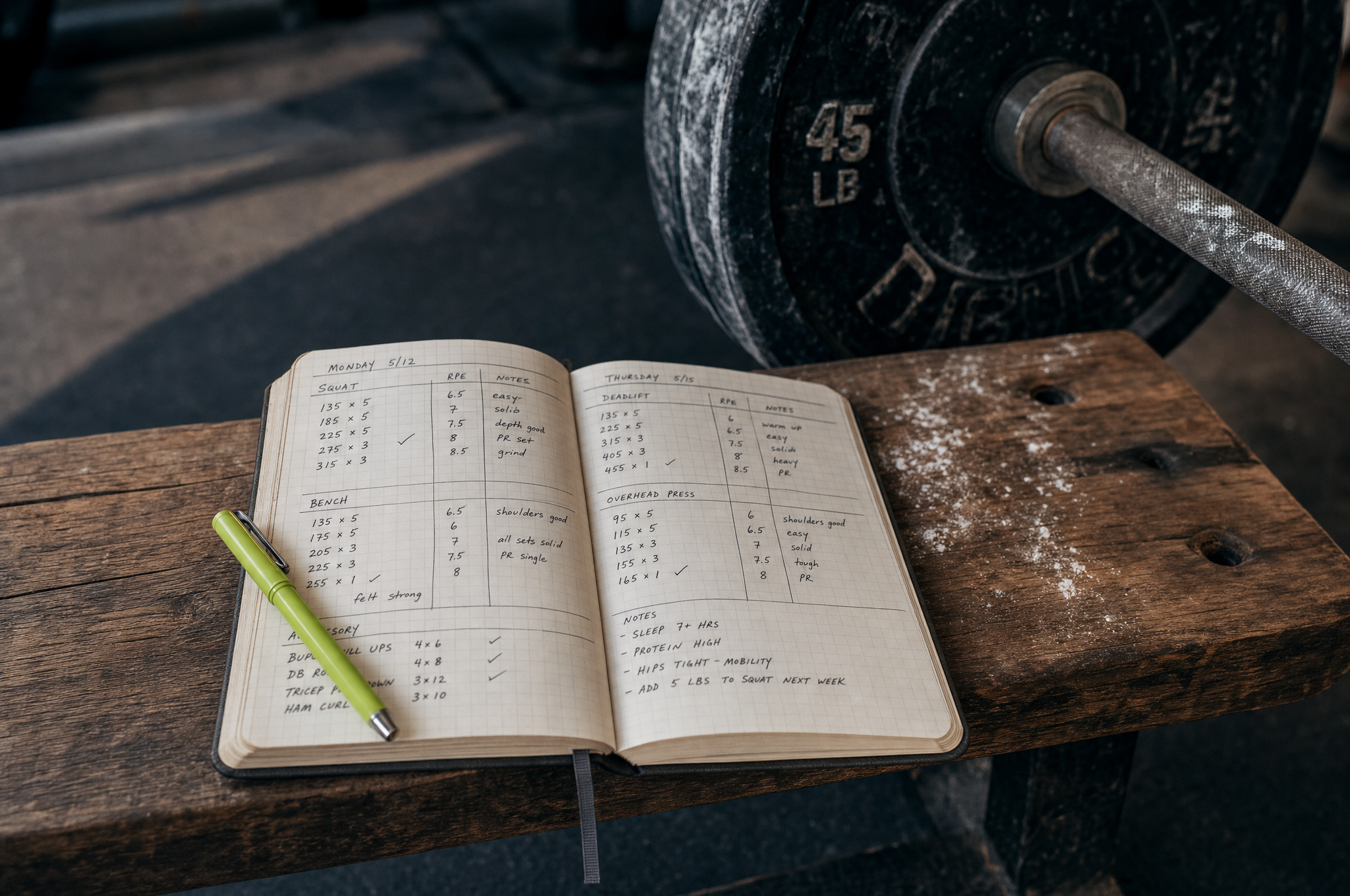
Strength training is simple. It's just not easy. The principle is one sentence: do a little more over time. The execution is where people get lost — in apps, spreadsheets, and percentage-based programs that require a math degree to follow.
This article is about stripping progressive overload down to what actually matters. No apps. No spreadsheets. No calculating percentages of one-rep maxes you've never tested. Just a notebook, a pen, and three rules that work whether you're in your first month or your tenth year of training.
What progressive overload actually means
Progressive overload is the gradual increase of stress placed on the body during exercise. That stress can come from:
- More weight on the bar
- More reps at the same weight
- More sets at the same weight and rep scheme
- Better form (more technically perfect execution at the same load)
- Less rest between sets
- Greater range of motion at the same load
Most people fixate on the first one — adding weight. But weight is only one variable. If you did 3 sets of 8 squats at 135 lbs last week and this week you did 3 sets of 9 at the same weight, that's progressive overload. If you did the same 3x8 at 135 but with deeper depth and cleaner form, that's progressive overload too. The principle is broader than "add five pounds."
The notebook framework
Here's the entire system. You need a cheap notebook and a pen. That's it.
What to write down
For each workout, write:
- The date
- Each exercise, the weight used, and the reps achieved per set
- A simple note on how it felt (e.g., "easy," "tough," "form broke on last set")
That's three data points per set. The note on perceived effort is the part most people skip — and it's the most useful. It tells you whether you're ready to add weight or should repeat the session.
A sample entry might look like:
June 10
Goblet Squat: 50lb x 10, 50lb x 10, 50lb x 9 (last rep tough, form held)
Push-up: 12, 10, 8 (felt strong)
KB Row: 35lb x 10/side, 35lb x 10/side, 35lb x 8/side
Notes: left hip felt tight — do 90/90s more consistently
The three rules
Now apply these three rules, in order:
Rule 1: The Rep Ceiling
Set a target rep range for each exercise — say, 3 sets of 8–12. When you can complete all three sets at the top of the range (12 reps in this example) with clean form and the last set didn't feel like a maximum effort, add weight next session. Small jumps: 5 lbs for upper body, 10 lbs for lower body. Then start back at the bottom of the range (8 reps) and build back up.
Rule 2: The Repeat Rule
If you hit the top of your rep range but the last set was a grind — form broke, you barely made it — repeat the same weight and reps next session. You haven't truly earned the weight increase until the current weight is under control. Strength isn't just hitting a number; it's owning it.
Rule 3: The Reset Rule
If you fail to hit your target reps (say, you got 8, 7, 5 instead of 8, 8, 8), repeat the same weight the following session. If you fail again for two consecutive sessions, take 10% off the weight and build back up. This is a mini-reset, not a step back — it's how you avoid stalling completely. For a deeper strategy on planned reductions, see our guide on deloading explained.
Why this works
The three rules handle every scenario: when to add weight (Rep Ceiling), when to hold steady (Repeat Rule), and when to back off (Reset Rule). You never need to calculate a percentage, look up a chart, or open an app. The notebook tells you exactly what to do next session because it tells you exactly what happened last session.
What about periodization?
Periodization — planned variation in training volume and intensity over time — is valuable for advanced lifters. But for your first few years, linear progression with the three rules above will take you further than any block periodization scheme. The complexity isn't justified until you're stalling on simple progression.
If you've been training consistently for 2+ years and progress has slowed, that's when periodization becomes relevant. Until then, the notebook framework is simpler, more sustainable, and more effective. The best program is the one you'll actually follow — and a notebook beats an app for adherence every time. Read more about why in our article on the problem with fitness tracking apps.
Tracking without numbers: the RPE method
If you train at home without standardized weights (bodyweight, kettlebells, sandbags), use Rate of Perceived Exertion (RPE) — a 1–10 scale of how hard a set felt. Track RPE alongside reps. When an exercise that was RPE 8 last month is now RPE 6 at the same reps, you've gotten stronger — even if the "weight" hasn't changed.
For bodyweight progressions, the progression is the exercise itself: move from wall push-ups to incline push-ups to floor push-ups to feet-elevated push-ups. Each variation is harder than the last. See our complete guide on bodyweight training progressions for the full ladder.
The weekly review
Once a week, flip back through your notebook and ask three questions:
- Did I train the number of sessions I planned? If not, what got in the way? (See habit stacking for fixing consistency.)
- Did I progress on at least one exercise? More weight, more reps, or better form — any counts.
- How did my body feel overall? Joints achy? Sleep suffering? Energy low? These are signals to adjust, not push through.
This review takes five minutes. It's where the notebook becomes a tool for adaptation, not just a record. You're looking for patterns: what's working, what isn't, and what needs to change.
What most people get wrong
The biggest mistake isn't in the tracking — it's in the expectations. People expect linear progress: add five pounds every week, forever. That works for about 3–6 months on major lifts, then it slows. This isn't failure; it's physiology. As you get stronger, progress comes in smaller increments, less frequently. A 5 lb increase on your squat every month is excellent progress for an intermediate lifter.
The second mistake is adding weight before form is solid. The Rep Ceiling rule prevents this — if the last set was ugly, you repeat. But ego can override the rule. Don't let it. Bad form at heavier weights is how injuries happen, and injuries are how progress stops entirely. If you need a refresher, our five fundamental movements guide covers form priorities.
The third mistake is tracking too much. You don't need to log rest times, heart rate, bar speed, or RPE for every warm-up set. Track the work sets. Track the weight, the reps, and a one-word effort note. That's enough data to make good decisions without turning your training into an accounting exercise.
Key takeaways
- Progressive overload is doing a little more over time — weight, reps, sets, form, range, or rest reduction all count.
- A notebook and pen are more effective than any app for tracking strength training.
- Three rules handle every scenario: Rep Ceiling (when to add), Repeat Rule (when to hold), Reset Rule (when to back off).
- Progress slows over time — that's normal, not failure. Smaller increments are still progress.
- Do a weekly 5-minute review: did I train as planned, did I progress on anything, how did my body feel?
Progressive overload is the single most important principle in strength training. It's also the most overcomplicated. A notebook, three rules, and a weekly review are all you need. The strength will come — not from the complexity of your tracking system, but from the consistency of your effort and the honesty of your notes.
Want to see how this fits into a complete beginner program? Start with the five fundamental movements, then use this framework to progress them. And if you're training at home, our guide to a home gym under $200 will get you set up.