I'll start with a confession: I've downloaded at least a dozen fitness apps over the years. I've tracked macros, logged workouts, monitored my heart rate, counted steps, and analyzed sleep — all from my phone. And for about two to three weeks each time, I was the most optimized version of myself. Then I stopped. Every time.
This isn't a personal failing. It's a design feature. Fitness apps are built to be engaging, not sustainable. And the very features that make them engaging in the short term — streaks, badges, notifications, gamification — are the same features that make them counterproductive in the long term. Here's why, and what to use instead.
The gamification trap
Most fitness apps borrow from video game design: streaks, badges, levels, leaderboards, push notifications. The intention is to make fitness "fun" and keep you coming back. But gamification changes your relationship with training in subtle, damaging ways.
The streak problem
Apps reward consecutive days of activity. Miss a day, lose your streak. This sounds motivating, but it creates two problems. First, it discourages rest days — you train not because you need to, but to preserve a digital badge. We've written about why rest days are essential; an app that punishes you for resting is actively undermining your recovery. Second, when the streak eventually breaks (and it always does — life happens), the motivation collapses. The streak was the motivation, and without it, there's nothing left.
The numbers problem
Apps turn training into data: calories burned, steps taken, reps completed, heart rate averaged. This data can be useful in moderation (see our heart rate zones guide), but when every workout becomes a quest to beat your numbers, you lose touch with your body. You train to feed the app, not to serve your goals. You push when you should back off, and you rest when you should push, because the app doesn't know what you need today — only what the algorithm rewards.
The notification problem
"You haven't logged a workout in 3 days!" "Close your activity ring!" These notifications create a low-grade anxiety around training. Exercise becomes another item on the to-do list, another source of guilt when you miss it. This is the opposite of the relationship you want with fitness — one that's driven by intrinsic motivation and genuine benefit, not by avoiding digital shame.
The engagement paradox
Apps need you to open them frequently — that's how they justify their existence (and their premium subscriptions). But frequent app use doesn't correlate with long-term fitness success. It correlates with short-term engagement followed by burnout. The people who train consistently for decades aren't checking an app — they've internalized the habit.
What the research says about tracking
Tracking itself isn't the problem — it can improve adherence and outcomes. The problem is how apps track. Research on behavior change suggests that the most effective tracking is:
- Simple: Minimal data, easy to record
- Self-directed: You control what and how to track, not an algorithm
- Low-friction: Doesn't require opening an app, navigating menus, or syncing devices
- Process-focused: Tracks behaviors (did I train today?) not just outcomes (calories, steps)
- Free of judgment: No streaks to break, no rings to close, no notifications to induce guilt
Most apps fail on at least three of these criteria. They're complex, algorithm-driven, high-friction, outcome-obsessed, and laden with guilt mechanics.
What to use instead
1. A notebook
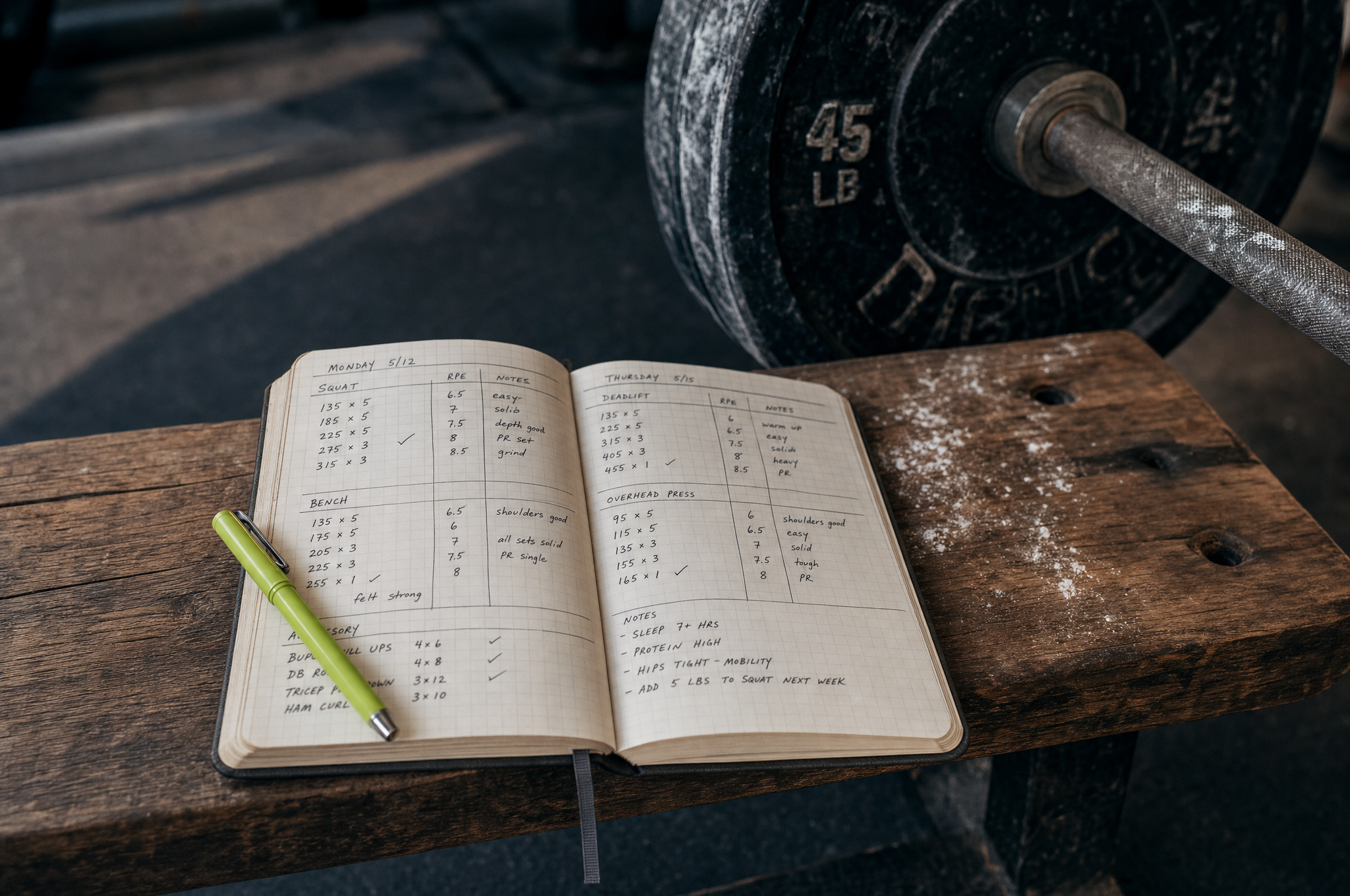
The most effective fitness tracking tool ever created costs $3 and fits in your gym bag. A notebook where you write down what you did, how it felt, and what you plan to do next. No syncing, no battery, no notifications. The physical act of writing reinforces focus and memory in ways that tapping a screen doesn't.
For strength training, see our complete progressive overload framework — it's built entirely around notebook tracking. Three data points per set: weight, reps, and a one-word effort note. That's it.
2. A calendar
For habit tracking, nothing beats a physical calendar on your wall. Mark an X on every day you train (or do your mobility routine, or hit your sleep target). The visual chain of X's is motivating without being gamified — there's no app to disappoint, no streak to "break." You just see your consistency (or lack of it) at a glance.
3. A simple spreadsheet (if you must)
If you want more structure than a notebook but less than an app, a spreadsheet works. Columns for date, exercise, weight, reps, and notes. No formulas, no charts, no dashboards. Just a record you can review.
4. Your body
The most important tracking tool is your own perception. How do you feel? Are you getting stronger? Is your sleep good? Are you recovering between sessions? No app measures these things better than you can. Learning to read your own body — energy, soreness, motivation, performance — is a skill that compounds over years. Apps short-circuit that skill by outsourcing it to an algorithm.
When apps are worth using
This isn't a blanket anti-technology argument. Apps have legitimate uses:
- Heart rate training: If you do structured cardio, a heart rate monitor (even an app-connected one) can keep your easy days easy and hard days hard. See our heart rate zones guide.
- Nutrition logging (temporarily): If you've never tracked your food, logging for 1–2 weeks can be eye-opening. But living with a calorie counter forever isn't sustainable for most people.
- Sleep tracking (with caution): Sleep data can be useful for identifying patterns, but obsessing over sleep scores can itself worsen sleep. See our article on sleep and strength.
The test is simple: does the app serve you, or do you serve the app? If you find yourself training to satisfy the app — closing rings, maintaining streaks, hitting arbitrary targets — the app is in charge. If you can use it as a passive tool that you check occasionally without anxiety, it might be fine. But most people are better off without.
The long game
Here's what nobody building a fitness app will tell you: the people who stay fit for decades don't track obsessively. They've internalized the habits. They train because it's what they do, not because an app told them to. They eat reasonably because it feels right, not because a calorie counter approved. They rest when they're tired, not when an algorithm suggests it.
This internalization takes time — months or years of consistent practice. Apps can help bridge the gap at the very beginning, when habits are new. But they should be training wheels, not a permanent crutch. The goal is to graduate from them.
For building the habits that make tracking unnecessary, read our guide on habit stacking. And if you're using an app to monitor rest days or recovery, compare its advice to what we cover in The Science of Rest Days — your body knows more than the app does.
Key takeaways
- Fitness apps use gamification (streaks, badges, notifications) that can undermine long-term consistency by externalizing motivation and discouraging rest.
- Effective tracking is simple, self-directed, low-friction, process-focused, and free of judgment — most apps fail these criteria.
- A $3 notebook is more effective for strength tracking than any app. Write weight, reps, and a one-word effort note per set.
- A physical calendar for habit tracking provides motivation without guilt mechanics.
- Use apps as temporary training wheels, not permanent crutches. The goal is internalized habits, not lifelong data dependence.
There's a profound difference between tracking your training and being tracked by your training. The best fitness tools are the ones that disappear — that let you focus on the work, not the interface. A notebook, a calendar, and your own attention are all you need. They're simpler, cheaper, and more durable than any app. And they'll still be working when the app you downloaded last month is gathering dust on your home screen.