Most mobility routines are either too short to matter or too long to sustain. This one is neither. Eight minutes, five movements, zero equipment — and it targets the three areas where stiffness actually limits your training: hips, thoracic spine, and shoulders.
Do it daily. Do it before training, after waking, or during a lunch break. The routine is sequenced from the ground up — feet and hips first, then spine, then shoulders — because mobility in the lower body affects everything above it.
How to use this routine
Each movement gets roughly 90 seconds. Move slowly. Breathe. This isn't a stretch-and-rush situation — the goal is to let your nervous system calm down and allow range of motion to increase naturally. Don't force anything. If a position feels sharp or painful, back off. See our disclaimer for guidance on when to seek professional help.
You don't need a yoga mat, but a soft surface helps for the kneeling movements. That's it. No bands, no blocks, no foam roller (though if you want to add one, see our foam rolling guide).
The five movements
Movement 1: 90/90 Hip Switches (90 seconds)
Sit on the floor with one leg bent in front of you at roughly 90 degrees and the other bent to the side at 90 degrees. Lean slightly forward into the front leg to feel a stretch in the hip capsule. Then rotate your knees to switch sides — the leg that was in front goes to the side and vice versa. Keep your hands on the floor for support. Move slowly: 3–4 seconds per switch, breathing out as you rotate.
Why it matters: The 90/90 position trains hip internal and external rotation simultaneously — the two ranges most limited by sitting. If you can't get into the position fully, sit on a cushion to elevate your hips. Depth will come with consistency.
Movement 2: Deep Squat Hold (90 seconds)
Drop into the deepest squat your mobility allows. Feet shoulder-width, toes slightly out. Let your hips sink toward the floor. If your heels lift, hold onto a door frame or post for support — the goal is to let your body settle into the position over time. Breathe slowly. Shift your weight gently side to side.
Why it matters: The deep squat is the resting position humans evolved to use. Modern chairs stole it. This hold restores ankle dorsiflexion, hip flexion, and thoracic extension in one movement. If you can hold a deep squat for two minutes, you're ahead of most people.
Movement 3: Cat-Cow with Thoracic Focus (90 seconds)
On all fours, alternate between arching your back (cow) and rounding it (cat), but shift the focus to your upper back — the thoracic spine. On the arch, push the floor away and let your chest drop. On the round, push the floor away with your hands and round between your shoulder blades. Move through each position for 3–4 seconds.
Why it matters: Thoracic stiffness is the hidden cause of shoulder pain, poor overhead mobility, and even lower back issues. This movement directly mobilizes the segment of the spine most affected by desk work.
Movement 4: Wall Slides (90 seconds)
Stand with your back against a wall. Press your head, upper back, and glutes into the wall. Raise your arms to shoulder height, elbows bent at 90 degrees, backs of your hands against the wall. Slide your arms up the wall as high as you can without your lower back arching off the wall, then lower them. Keep the backs of your hands and wrists in contact with the wall throughout.
Why it matters: Wall slides train scapular upward rotation and shoulder flexion — the exact movements you need for overhead presses, pull-ups, and reaching overhead without compensating through the lower back. If your hands lift off the wall, you've found your limitation.
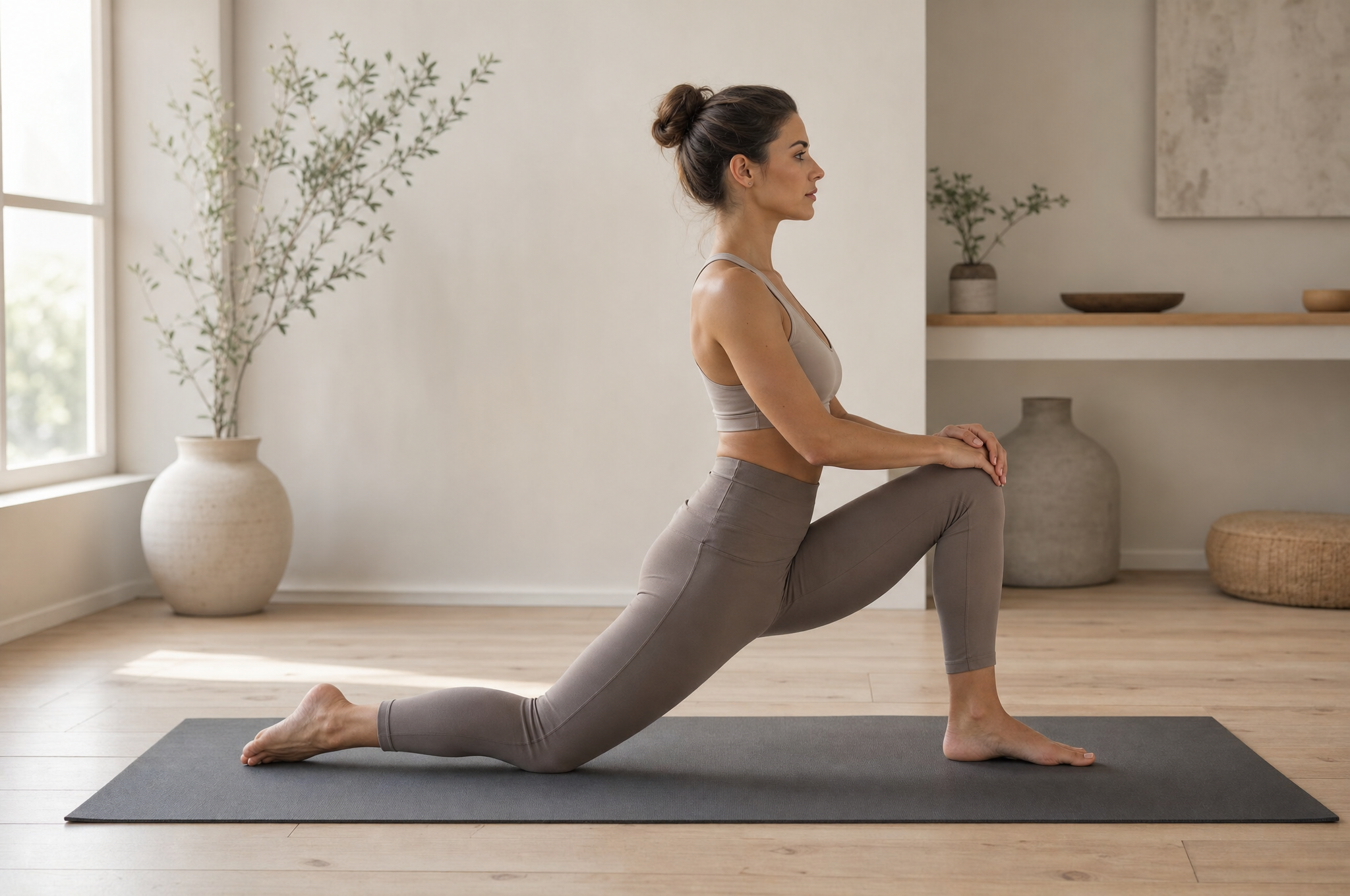
Movement 5: Half-Kneeling Hip Flexor Stretch (90 seconds per side)
Kneel on one knee with the other foot in front, both at 90 degrees. Squeeze the glute of the kneeling side — this is the key most people miss. Without squeezing, the stretch is passive and far less effective. Once you squeeze, gently shift your weight forward until you feel a stretch in the front of the hip on the kneeling side. Hold for 45 seconds, then switch sides.
Why it matters: Tight hip flexors from sitting tilt the pelvis forward, which flattens the lower back and weakens the glutes. This stretch, done with an active glute squeeze, directly addresses that pattern.
The total: 8 minutes
90 seconds per movement, five movements. If you do both sides of the half-kneeling stretch (recommended), you're at about 9.5 minutes. That's fine — the routine is a guide, not a stopwatch.
What to expect
Week 1–2: Things will feel stiff. Some positions will be difficult. That's normal. Don't judge your mobility by day one — judge it by day 30.
Week 3–4: You'll notice the 90/90 switches getting smoother and the deep squat feeling more natural. Thoracic extension will start to improve, and wall slides will feel less restricted.
Week 6+: This is where the routine pays dividends in your training. Your squat depth improves. Your overhead press feels more stable. Your lower back doesn't ache after deadlifts. The eight minutes you invested daily is now paying interest.
Mobility vs. stretching: what's the difference?
Stretching typically means holding a muscle in a lengthened position to increase flexibility. Mobility is broader — it's about usable range of motion, which includes joint capsule range, soft tissue extensibility, and neuromuscular control. This routine is mobility work, not just stretching. Each movement asks your nervous system to control a range of motion, not just passively hang out in it.
The research on stretching alone is underwhelming — static stretching before exercise can even reduce power output. Mobility work that incorporates active control and movement through ranges is a different animal entirely, and the evidence supports it for improving movement quality and reducing injury risk.
Common questions
Should I do this before or after training? Either works. Before training, it prepares your joints for load. After training, it helps consolidate range of motion. The best time is whatever time you'll actually do it consistently. For more on building consistency, see our guide on habit stacking for fitness.
Can I do it more than once a day? Yes. Mobility work is low-intensity and recovers quickly. Doing it morning and evening is fine. Don't overdo any single position — more isn't always better.
What if I have an injury? Stop and consult a physical therapist. Mobility routines are preventive and general. They're not rehabilitation. See our disclaimer for more detail.
Key takeaways
- Eight minutes, five movements, zero equipment — this routine targets the three areas most people need work: hips, thoracic spine, shoulders.
- Mobility is not just stretching. It's active control through range of motion.
- Consistency beats intensity. Do it daily for 30 days before judging results.
- The 90/90 switch, deep squat hold, cat-cow, wall slides, and half-kneeling stretch cover the most ground in the least time.
- If it hurts, stop. Sharp pain is a signal, not a challenge.
This routine won't make you a gymnast. It won't fix a serious injury. But it will address the stiffness that creeps in from sitting, training, and living — and it'll do it in less time than it takes to scroll through your phone. That's the point.
Want to build this into your daily routine? Read our guide on habit stacking to anchor it to something you already do. And if you're just starting strength training, the five fundamental movements pair perfectly with this mobility work.