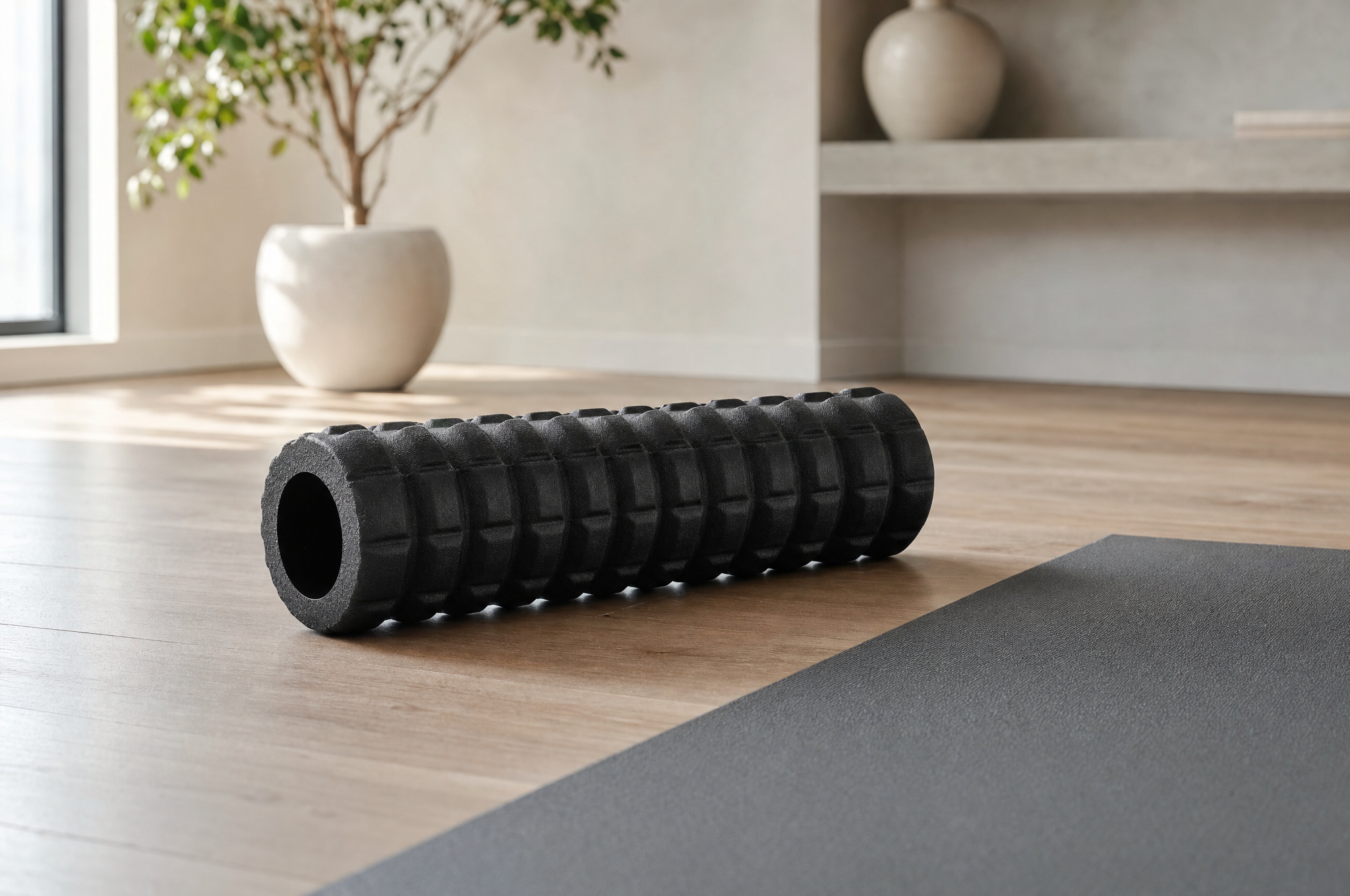
The foam roller is one of the most misunderstood tools in fitness. Some people treat it like a magic wand — roll for five minutes and your tight muscles will release, your performance will improve, and your recovery will accelerate. Others dismiss it as a waste of time, pointing to studies that show limited effects. The truth, as usual, is in the middle.
Here's what the evidence actually says about foam rolling, what it can and can't do, and how to use it in a way that provides real benefit.
What foam rolling actually is
Foam rolling is a form of self-myofascial release (SMR) — applying pressure to soft tissue (muscle and fascia) using a cylindrical foam roller. The theoretical mechanism was originally described as breaking up adhesions or "knots" in fascia, the connective tissue surrounding muscle. This explanation is now largely discredited — the pressure required to physically deform fascia is far beyond what a foam roller can deliver.
The current, evidence-supported explanation is that foam rolling works through neurological mechanisms. The pressure stimulates receptors in the muscle and skin that signal the nervous system to reduce muscle tone — essentially, your brain tells the muscle to relax. Additionally, foam rolling may increase local blood flow and produce a short-term increase in range of motion through these neurological effects.
This distinction matters because it sets realistic expectations. Foam rolling doesn't "release" tissue in the mechanical sense. It modulates your nervous system's output. The effect is real but temporary.
What foam rolling does (evidence-supported)
1. Short-term increase in range of motion
Multiple studies show that foam rolling increases joint range of motion in the short term — typically for 10–30 minutes after rolling. This makes it useful as part of a warm-up if you need increased mobility for a specific session (e.g., rolling your calves before squatting to improve ankle dorsiflexion). However, the effect doesn't appear to be cumulative — rolling daily doesn't permanently increase range of motion the way that active mobility training does.
2. Reduced perception of muscle soreness (DOMS)
Several studies have found that foam rolling after intense exercise reduces the perception of delayed-onset muscle soreness (DOMS) in the days following. This doesn't mean the muscle damage is reduced — it means the sensation of soreness is dampened. If you're too sore to train effectively, foam rolling may help you feel better enough to train, which can indirectly improve recovery (by allowing you to move).
3. Acute recovery between sessions
Some research suggests foam rolling in the hours after training can reduce markers of muscle fatigue and improve performance on subsequent days. The effect is modest, but for athletes training multiple times per day or on consecutive days, it may provide a small edge.
What foam rolling doesn't do
- It doesn't break up scar tissue or fascial adhesions. The force required is orders of magnitude higher than a foam roller can provide. The mechanism is neurological, not mechanical.
- It doesn't improve long-term flexibility. The range of motion increase is temporary. For lasting mobility improvements, you need active movement through range — see our 8-minute mobility routine.
- It doesn't improve athletic performance directly. Some studies show no performance benefit; a few show a small negative effect if done too aggressively before explosive movements. It's not a performance enhancer — it's a recovery and preparation tool.
- It doesn't replace stretching or mobility work. Foam rolling reduces muscle tone; stretching lengthens tissue. They're complementary, not interchangeable.
- It doesn't "detoxify" muscles. There's no evidence that foam rolling removes toxins or metabolic waste. Your circulatory and lymphatic systems handle that.
The "no pain, no gain" fallacy
The most common foam rolling mistake: rolling so hard it's excruciating, under the belief that more pain equals more benefit. It doesn't. High pain triggers a protective response — your nervous system increases muscle tone to guard against perceived threat, the opposite of what you want. Effective foam rolling should be uncomfortable but tolerable. If you're grimacing and holding your breath, back off.
How to actually do it
What you need
A basic foam roller — firm, smooth surface, about 6 inches in diameter and 12–36 inches long. Don't start with a textured or knobby roller; they're more aggressive and less comfortable. A simple dense foam roller is all you need. (See our home gym guide — a foam roller is an optional but useful $15–$20 addition.)
The protocol
- Target one muscle group at a time. Quads, hamstrings, calves, upper back, lats. Avoid rolling directly over joints, bones, the lower back (lumbar spine), or the neck.
- Roll slowly. About 1 inch per second. Speed doesn't help — the nervous system needs time to respond to the pressure.
- Spend 60–90 seconds per area. Longer isn't better. A few focused minutes on the areas that need it beats an hour of indiscriminate rolling.
- Pause on tender spots. When you find a sensitive area, hold still on it for 20–30 seconds and breathe. The discomfort should decrease as the nervous system adapts.
- Keep pressure moderate. You should be able to breathe normally and maintain a conversation. If you can't, reduce the pressure (support some weight with your arms or legs).
- Never roll the lower back. The lumbar spine has minimal muscle between the bones and the skin. Rolling directly on the lower back can cause injury. If your lower back is tight, roll the surrounding muscles (glutes, upper back, lats) instead.
When to do it
- Before training (5–10 minutes): As part of your warm-up, focusing on the muscles you're about to train. The short-term range of motion increase can help you achieve better positions.
- After training (5–10 minutes): To reduce post-workout soreness perception and begin recovery. Pair with proper rest and adequate sleep.
- On rest days: Light rolling can help with blood flow and soreness management without imposing significant training stress.
- Not during a deload: Keep deload weeks genuinely light. Foam rolling is fine, but don't turn it into another training stress.
The key areas to roll
Quads
Lie face down, roller under your thighs. Support your upper body on your forearms. Roll from hip to knee, slowly. Pause on any tender spots.
Hamstrings
Sit on the floor, roller under your thighs. Lift your hips and roll from knee to glute. Keep the pressure moderate — the hamstrings are sensitive.
Calves
Sit on the floor, roller under your lower legs. Cross one leg over the other to increase pressure. Roll from ankle to knee.
Upper back (thoracic spine)
Lie on your back, roller under your upper back (between shoulder blades). Support your head with your hands. Roll from mid-back to the base of your neck. This is one of the most beneficial areas for desk workers.
Lats
Lie on your side, roller under your armpit. Roll from armpit to mid-ribcage. Keep your arm overhead to stretch the tissue as you roll.
Glutes
Sit on the roller, cross one ankle over the opposite knee. Lean toward the crossed-leg side. Roll the glute of the crossed-leg side.
Key takeaways
- Foam rolling works through neurological mechanisms (reducing muscle tone), not by physically breaking up tissue.
- It provides a short-term (10–30 min) increase in range of motion and reduces the perception of muscle soreness.
- It does not improve long-term flexibility, break up scar tissue, or directly enhance performance.
- Roll slowly (1 inch/second), 60–90 seconds per area, moderate pressure. Never roll the lower back.
- Foam rolling is complementary to — not a replacement for — active mobility work, stretching, and rest.
Foam rolling is a useful tool with modest, short-term benefits. It's not the cornerstone of recovery that marketing makes it out to be, but it's not the waste of time that skeptics claim either. Use it as one part of a recovery strategy that includes mobility work, quality sleep, scheduled rest, and good nutrition. The roller doesn't do the work — your body does. The roller just helps a little.